Author: Rajmahendra

  • Full Moon Day Group Sitting: 1 May 2026

    Full Moon Day Group Sitting: 1 May 2026

    Reaching the Island of Peace through Metta Vipassana

    Reaching the Island of Peace through Metta Vipassana

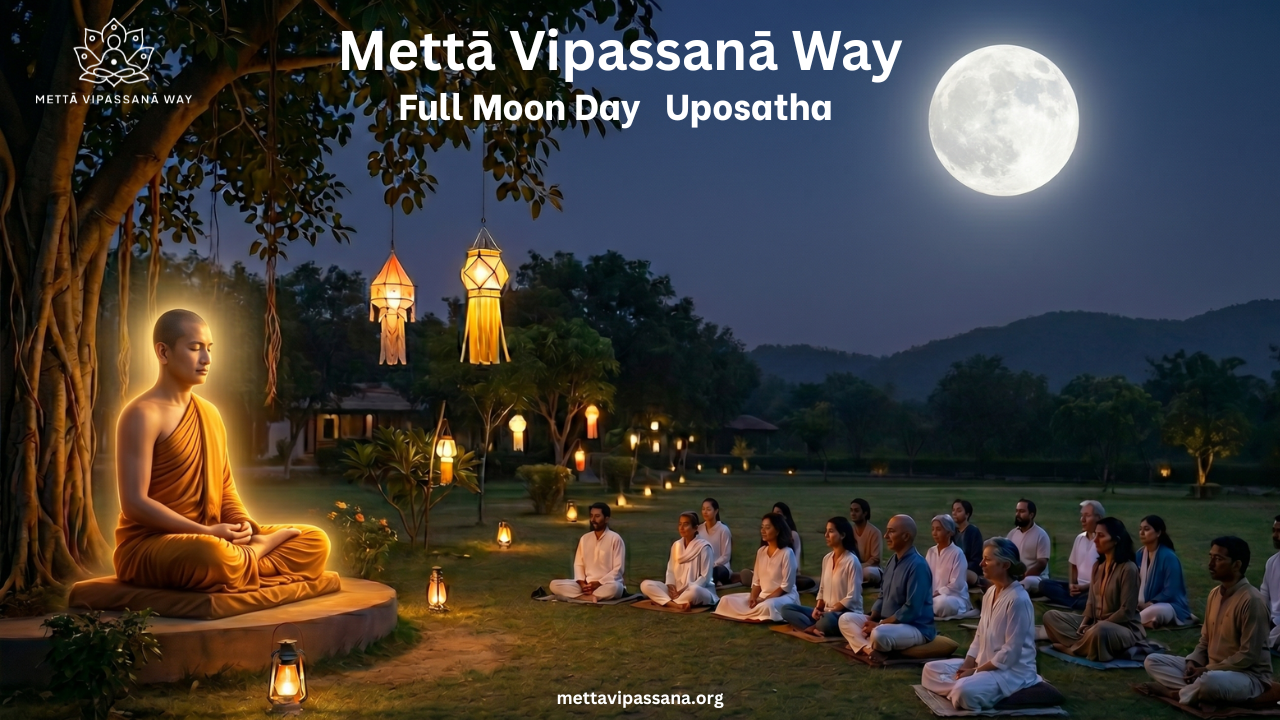
    On the recent Full Moon day group sitting on 1 May 2026, our community gathered online for a heart-opening session led by Ven. Bhante Dhammagavesi. Even with the busy schedule of a newly started Retreat, Bhante shared a beautiful reminder of why we pause our lives to practice. He focused the evening on the ultimate goal: reaching the island of peace through Metta Vipassana.

    The Foundation: Living with Purpose

    Bhante began the session by discussing the Eight Precepts. He explained that these are not just rigid rules. Instead, they represent the natural mind-states of an Arahan (an enlightened being).

    By following these precepts on special days like the Full Moon, we align our minds with clarity. The practice includes non-violence, honest speech, and a simple lifestyle. By stepping away from worldly distractions for a day, we create the perfect environment for deep insight.

    The Story of the Clever Earner

    During the 1 May 2026 session, Bhante shared a powerful teaching from the Anguttara Nikaya. He used a financial analogy to show the limits of material success.

    Imagine a man who accumulates a massive fortune over a century. Bhante asked if this wealth could buy even half a day of true, exclusive happiness. The answer is a clear “No.” Worldly pleasures are impermanent and deceptive. In contrast, one day of sincere meditation acts as a vital step toward reaching the island of peace through Metta Vipassana.

    The Ocean and the Island

    Bhante shared a vivid metaphor of a person in a vast ocean to help us track our progress:

    • Drowning: This represents being lost in heavy, unwholesome habits.
    • Floating: This is the average life where we stay steady but have no clear direction.
    • Seeing the Island (Stream-Enterer): This is the first major milestone. You finally see the land and know which direction to swim.
    • Swimming Toward the Island (Once-Returner): You make an active effort to shed the burdens of lust and aversion.
    • Wading through the Shallows (Non-Returner): You touch the sand. At this stage, the deep ocean can no longer sweep you back.
    • Sitting on the Island (Arahan): You reach the destination and live without the fear of drowning.

    Bhante emphasized that we do not need years to find the shore. If we practice correctly, even a single day of effort sets us firmly on the path.

    Q&A: Understanding “Empty” Pleasures

    The session concluded with an insightful discussion on the nature of pleasure. A student asked why worldly pleasures are called “false.” Bhante used a sobering example of a person with an itch who holds their hand over hot coals. The heat provides temporary relief, but it actually burns the flesh and causes deeper harm.

    Worldly pleasures often cost us our peace. However, joys found in meditation—like Metta or Equanimity—are different. With awareness, we enjoy life’s “cool breeze” without getting “tricked” into thinking it will last forever.

    Ending the Day

    The Full Moon day group sitting on 1 May 2026 ended with a sense of shared joy. One participant noted how just 12 days of consistent practice had already improved their inner happiness.

    Whether you are just learning to float or are already swimming hard, practicing together makes reaching the island of peace through Metta Vipassana much easier. We invite you to join our next group sitting and continue the journey.

    May all beings find their way to the island of peace.

  • Full Moon Day Uposatha April 2026

    Full Moon Day Uposatha April 2026

    Full Moon Day Uposatha April 2026

    On this recent Full Moon Day Uposatha , our community met on Zoom for an inspiring discourse with Ven. Bhante Dhammagavesi. We dedicated this session to the ancient tradition of Uposatha. This is a special day for practitioners to intensify their meditation and purify their minds.

    The Hidden Value of the Uposatha Sutta

    Bhante opened the talk by discussing the Uposatha Sutta. He addressed a common doubt: can just one day of meditation really make a difference? To answer this, he shared a powerful comparison from the ancient texts.

    Even if a person ruled sixteen great kingdoms with all their gold and jewels, that earthly wealth would not equal even a tiny fraction of the value of one Uposatha day. While worldly power fades, the mental merit and peace you earn through sincere practice stay with you forever.

    Clearing Space for the 6Rs

    To honor the Full Moon, we follow eight training factors. Bhante explained that these are not meant to be “strict rules.” Instead, they act as a way to simplify our lives. By setting aside distractions and luxuries for twenty-four hours, we quiet the “outside” world. This silence makes it much easier to use the 6R technique and see exactly how our mind works.

    Wisdom: The Goal of Our Practice

    The session included an active Q&A where we discussed the true purpose of meditation. Bhante clarified that we are not just looking for a “calm feeling.” The real goal is Wisdom.

    By using the 6Rs (Recognize, Release, Relax, Re-smile, Return, Repeat), we learn to catch the mind before it gets angry or stressed. This allows us to live like a lotus flower. Just as a lotus rises above muddy water without getting dirty, a practitioner lives in a busy world but remains “unsmeared” by its troubles.

    Forgiveness and Internal Strength

    Bhante also shared how to handle “blockages” in practice. For those feeling stuck or in pain, he recommended Forgiveness Meditation. This practice acts like a deep internal cleaning, dissolving old emotional knots so that Loving Kindness can flow again.

    He ended with a beautiful reminder: a soft, smiling heart is not a weakness. In fact, it is a sign of immense strength. When we take care of the teachings, the teachings naturally take care of us.

    Join Our Next Full Moon Session

    This discourse reminded us that the path to peace is simple and open to everyone. You do not need to be an expert; you only need an eagerness to learn and an open mind.

    I encourage you to attend our next session. It is a wonderful opportunity to experience the Uposatha tradition and the joy of an effortless practice. Come and discover the bliss of a smiling heart with our community.

    We look forward to practicing with you at the next Full Moon!

  • Overcoming the Fear of Loss through Meditation: A Dhamma Reflection

    Overcoming the Fear of Loss through Meditation: A Dhamma Reflection

    How Metta and Wisdom Help in Overcoming the Fear of Loss through Meditation

    I was meditating, as I do every day. But on this day, I sensed that something was not quite right in my personal life. A family member was unwell, and somewhere deep within, I could feel the fear of losing a loved one. At some level, I know that one day each of us will have to face such a situation. Still, when it comes close, the mind reacts.

    As I began my meditation, I noticed a strong reaction in the body—almost like a biochemical shift. Tears began to flow from my eyes. I understood that this was the fear of losing someone dear.

    I allowed the tears to come. I did not resist. There was a sense of helplessness—just being there, emotionally low, observing it.

    Redirecting Toward Metta

    Gradually, I started reflecting and gently redirecting the mind towards Metta—first towards myself, and then towards my family member. It came to me that even though I practice loving-kindness meditation, keep my precepts, and follow the Dhamma, it does not mean that I will not suffer.

    Not everything is perfect all the time. This is impermanence. I began to see that the suffering was being created by my own holding on—thoughts like:

    • “What if that person is no more?”
    • “What will I do without them?”
    • “May they suffer less…”

    I could clearly see this as mental proliferation. Then I recollected something from my first retreat:

    “We are doing all this practice to learn how to die, to let go of suffering.”

    I continued my sitting, radiating metta to myself, to my family members, and to all beings. With a mind inclining towards equanimity, I ended the sitting.

    The Wisdom of the Sutta

    The next day, during our Sunday reading, I opened a sutta from the Samyutta Nikaya 35.136—on delighting in forms. As I listened to the teaching and reflected, it felt as though the missing pieces of a puzzle were falling into place.

    The opening line struck me deeply:

    “Bhikkhus, devas and humans delight in forms, take delight in forms, rejoice in forms. With the change, fading away, and cessation of forms, devas and humans dwell in suffering.”

    I could see this in my own experience. The fear was arising because of taking things personally—I, me, mine.

    Through the six sense bases—eye, ear, nose, tongue, body, and mind—we experience the world. But we begin to assume permanence. When things change, we resist. We want things to be as we want them to be, and in doing so, we create suffering.


    Reflections from the Samyutta Nikaya

    The sutta further explains this beautifully in verse:

    “Forms, sounds, odours, tastes,

    Tactiles and all objects of mind—

    Desirable, lovely, agreeable,

    So long as it’s said: ‘They are.’

    “These are considered happiness

    By the world with its devas;

    But where these cease,

    That they consider suffering.

    “The noble ones have seen as happiness

    The ceasing of identity.

    This view of those who clearly see

    Runs counter to the entire world.

    “What others speak of as happiness,

    That the noble ones say is suffering;

    What others speak of as suffering,

    That the noble ones know as bliss.

    “Behold this Dhamma hard to comprehend:

    Here the foolish are bewildered.

    For those with blocked minds it is obscure,

    Sheer darkness for those who do not see.

    “But for the good it is disclosed,

    It is light here for those who see.

    The dullards unskilled in the Dhamma

    Don’t understand it in its presence.

    “This Dhamma isn’t easily understood

    By those afflicted with lust for existence,

    Who flow along in the stream of existence,

    Deeply mired in Mara’s realm.

    “Who else apart from the noble ones

    Are able to understand this state?

    When they have rightly known that state,

    The taintless ones are fully quenched.”


    I hope you could connect your own points while reading this sutta—happy reading and reflection.

    With Mētta,