
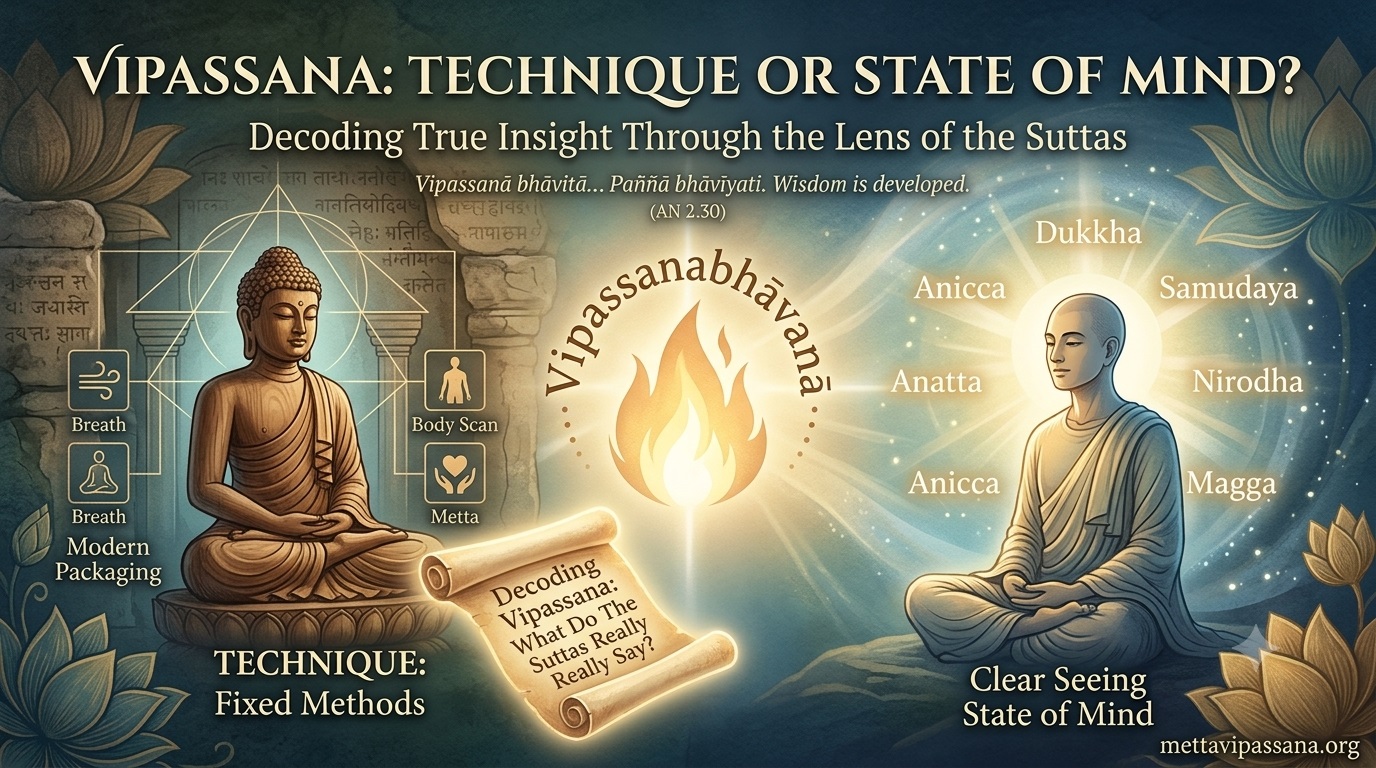
Many people today associate Vipassana practice and meaning with a specific meditation technique, retreat format, or meditation brand. It is common to hear people say, “I am doing Vipassana,” or “I attended a Vipassana course.”
In almost all my Metta Vipassana Way retreats, people usually ask me this common question: Raj Sir…
is this just another Vipassana method to practice?
I have already attended Vipassana classes from other schools, so why aren’t you teaching Anapana or breath meditation, here?
Why are we not focusing on the area below the nose and above the lip?
Why is there no body scanning at all?
All these are completely valid questions. But the problem is, we are all missing the main point by looking at it out of context
Rather than comparing different meditation schools, I would like to explore what the Buddha himself taught. To do that, we must return to the earliest sources available—the Sutta Pitaka.
Instead of relying primarily on later interpretations and commentaries, let us examine the teachings through the words of Siddhattha Gotama, the Buddha. By doing so, we can better understand the true Vipassana practice and meaning as presented in the early texts.
The History of the Modern Meditation Package
Let us look at how history changed things. Centuries after the death of the Buddha, a prose book called the Visuddhimagga (The Path of Purification) was written. The author took around 40 different meditation methods scattered across the Buddha’s Suttas and listed them all inside this one single book. Looking closely, I can say that this is how so many modern meditation packages emerged today—by copying, mixing, and matching completely independent methods from this text into a single routine.
Like many practitioners, I spent years searching, reading, and practicing different systems to find that one perfect method. My personal quest finally ended when I discovered Bhante Vimalaramsi.
I deeply resonated with his quest of going back to the absolute roots. Instead of reading later interpretations and commentaries, he went to get the direct evidence from the Buddha by reading the Sutta Pitaka. The main quote I learned from this journey is:
Let us read and earn directly from the horse’s mouth, rather than reading so many different commentaries.
What Does Vipassana Really Mean?
To understand why the modern packaging is misleading, we must look at the true Vipassana practice and meaning. Let us first understand the actual word itself. In Pāli:
What Does Vipassana Really Mean?
Vipassanā = “Clear seeing” or “Insight”.
In the early Buddhist texts, Vipassana is not presented as a meditation brand or a fixed technique. Rather, it refers to a quality of clear seeing that develops through practice. It is the insight that arises when we observe experience deeply and understand its true nature.
Vipassana in the Early Buddhist Suttas
Look at the Majjhima Nikaya (MN 19), where the Buddha says:
Vipassanaṃ bhāvesiṃ,
I cultivated or developed insight.
When a practitioner watches their mind, sees thoughts arising and passing away, and thus directly sees the Four Noble Truths—that is how Vipassana is developed.
The Suttas never say,
Aṅgulimālo vipassanābhāvanaṃ akāsi
Angulimala did the Vipassana technique.
Instead, they say he was
appamatto atapi
(diligent and ardent), and then annaya —he directly knew Nibbana.
Vipassana was the state of insight he achieved, not a physical drill he practiced.
In modern times, we casually say,
I am doing Vipassana
I use the Vipassana technique, or
I am going for a 10-day Vipassana.
But the Suttas say: I am developing Vipassana—meaning, insight into Anicca (impermanence), Dukkha (unreliability), and Anatta (non-self).
Over time, however, the meaning of the word has shifted. What was originally a description of insight has increasingly become the name of a meditation method, retreat format, or organisational approach. This shift can sometimes obscure how the Buddha used the term in the Suttas.
Why the Buddha Did Not Teach a One-Size-Fits-All System
Before I break down how the Buddha treated these practices, let me share a major incident from the scriptures.
In the Maha-Rahulovada Sutta (MN 62), the Buddha teaches his son, Rahula, a series of different meditations in tandem (one after the other). The Buddha never just blindly weaved a rigid, single system. He provided specific tools to solve the specific mental challenges Rahula was facing at that time.
Taking this as our cue, we can see that a single “one-size-fits-all” package goes against the Buddha’s personal way of teaching! The Buddha uniquely designed distinct meditation practices for distinct purposes, rather than throwing them into one basket.
Anapanasati: More Than a Preparation Technique
In modern packages, Anapana (breath awareness) is often taught as a simple, mechanical warm-up exercise to build concentration before beginning the “actual” system of body scanning. But let us see what the Suttas actually say about this wonderful system.
In the Anapanasati Sutta (MN 118), the Buddha explains that Anapana is a complete process from start to finish. He lays down 16 distinct steps to breath meditation. He explicitly states that when a person fully practices these 16 steps, they do not need to switch to another technique at all! Why? Because the breath itself fully satisfies the Four Foundations of Mindfulness and completely awakens all Seven Factors of Liberation.
The unique psychological purpose of Anapana is to cut through mental wandering and restlessness. As the Meghiya Sutta states:
Vitakkupacchedāya ānāpānassati bhāvetabbā.
Mindfulness of breathing should be cultivated to cut off distracting thoughts.
Vipassana as Insight Rather Than Technique
“Monks, when you practice the Vipassana technique, insight develops.” Vipassana is not a technique or a system; it is the state of mind of insight and wisdom (Panna) itself. So when you refer to Vipassana, do not say, I am doing Vipassana. Say, I cultivate or develop it. It is a state of mind, not a mechanical chore.
Mettā as a Complete Path of Practice
In modern mixed courses, Metta or Metta Bhavana has been reduced to a short 10-minute closing practice at the very end of a heavy retreat. It is treated like a closing prayer or a dedication to smooth over emotional intensity caused by forced concentration.
In sharp contrast, the Buddha had a very different perspective. He saw Metta as a vast, powerful, and completely independent path capable of reaching Nibbana in a soft and effortless way. He packaged it and called it Brahmavihara (The Divine Abode) and Metta-Ceto-Vimutti (The Liberation of Mind through Loving-Kindness).
In the Meghiya Sutta (Udana 4.1), the Buddha says:
Metta, Meghiya, bhavetabba vyapadassa pahanaya.
Loving-kindness should be cultivated to abandon ill-will.
To show its supreme value, the Buddha compares different meritorious deeds in the Velama Sutta (Anguttara Nikaya 9.20). He states that building monasteries or feeding thousands of enlightened beings is highly valuable.
Then he adds:
Yet, it is far more meritorious to cultivate a mind of loving-kindness (mettā-cittaṁ) even for the duration of a single snap of the fingers, than to give gifts to the world.
Why?
Because a single second of true Metta completely softens and purifies the deep layers of the subconscious mind.
When you radiate Metta, the mind naturally enters a state of deep, unshakeable concentration (Samadhi).
Because the mind is entirely empty of irritation, fear, and craving during this radiation, it becomes perfectly transparent (Metta-sahagata Sutta,
Samyutta Nikaya 46.54).
From this highly refined, expansive state, the practitioner applies intelligent observation. They look directly at this peaceful state itself and realize:
This beautiful state is conditioned and sustained by awareness. Therefore, it too is subject to change (Anicca), it is coreless and empty of a permanent self (Anatta).
Through this direct insight, the mind lets go and attains Nibbana.
Stop “Doing” and Start “Cultivating”
When we look deeply at the Vipassana practice and meaning, we realize that it is not a mechanical task or a physical body-scanning drill you perform. It is the ultimate state of insight and wisdom that sets you free.
Every meditation method taught by the Buddha is independently beautiful, powerful, and designed to solve specific mental challenges. When we mix them up into a single standardized meditation package and label it under one brand name, we lose their unique power. Let us stop treating meditation like a rigid corporate package and start cultivating clear seeing the way the Buddha intended.
Frequently Asked Questions
Is Vipassana a meditation technique?
According to the early Buddhist Suttas, Vipassana primarily refers to insight or clear seeing rather than a specific meditation technique.
What does Vipassana mean in Pali?
Vipassana means “clear seeing,” “insight,” or “seeing things as they truly are.”
Did the Buddha teach body scanning as Vipassana?
The early Suttas describe several meditation approaches. However, they do not present Vipassana as a single standardized technique.
Can Metta lead to enlightenment?
Several Suttas describe Mettā as a powerful practice that can support liberation when cultivated fully and combined with wisdom.
If Vipassana is just a state of mind and not a physical action, how do we actually practice it daily?
In the original teachings, peace (Samatha) and sharp understanding (Vipassana) always go hand in hand. You don’t do them separately. To get this clear state of mind, we use a simple, gentle method called the 6Rs (Recognize, Release, Relax, Re-smile, Return, Repeat). Whenever a distracting thought pops up, you don’t fight it. You just let it go, relax your mind, smile, and gently come back to your meditation. This naturally clears up the mind.
What is the main difference between modern meditation packages and a traditional Sutta-based retreat?
Most modern 10-day courses follow later books like the Visuddhimagga. They mix and match different exercises—like forcing you to watch your breath for days just to build concentration, and then suddenly switching to a body-scanning drill. But a Sutta-backed retreat goes straight to the Buddha’s original words. Here, we pick one practice, like Mettā (Loving-Kindness), and it carries you all the way to the end safely and smoothly, without any mixing.
Why is the “Relax” step in the 6Rs so important for getting true insight?
This is the secret step that many modern meditation styles completely missed! In the old scripts, the Buddha always said to calm down the tension in your body and mind. When a distraction comes, it actually creates a tiny, hidden tightness in your brain. If you don’t relax that tightness, your mind stays stressed. The “Relax” step unties that knot, removes the irritation, and lets you see things exactly as they are.
Is “Metta Vipassana” something different from TWIM meditation?
No, they are 100% the same thing! Metta Vipassana (or the Metta Vipassana Way) is just a friendly, modern name used by the MettaInsight Foundation. It is the exact practical way of doing TWIM meditation, which was revived by Bhante Vimalaramsi from the Buddha’s core teachings on Loving-Kindness (Brahmaviharas). Different names, but the exact same engine inside!
I am a complete beginner. Can I join a Metta Vipassana Way retreat, or is it too tough?
You can absolutely join! Frankly speaking, being a beginner is actually a big plus. You don’t have to “unlearn” any rigid habits or forceful concentration styles from other places. The practice is very gentle, happy, and natural. We guide you step-by-step from day one, so anyone can do it easily.
Where can I find upcoming retreats in my City ?
Find all our retreats here : Join Upcoming Online, Short and Residential Retreats.
