
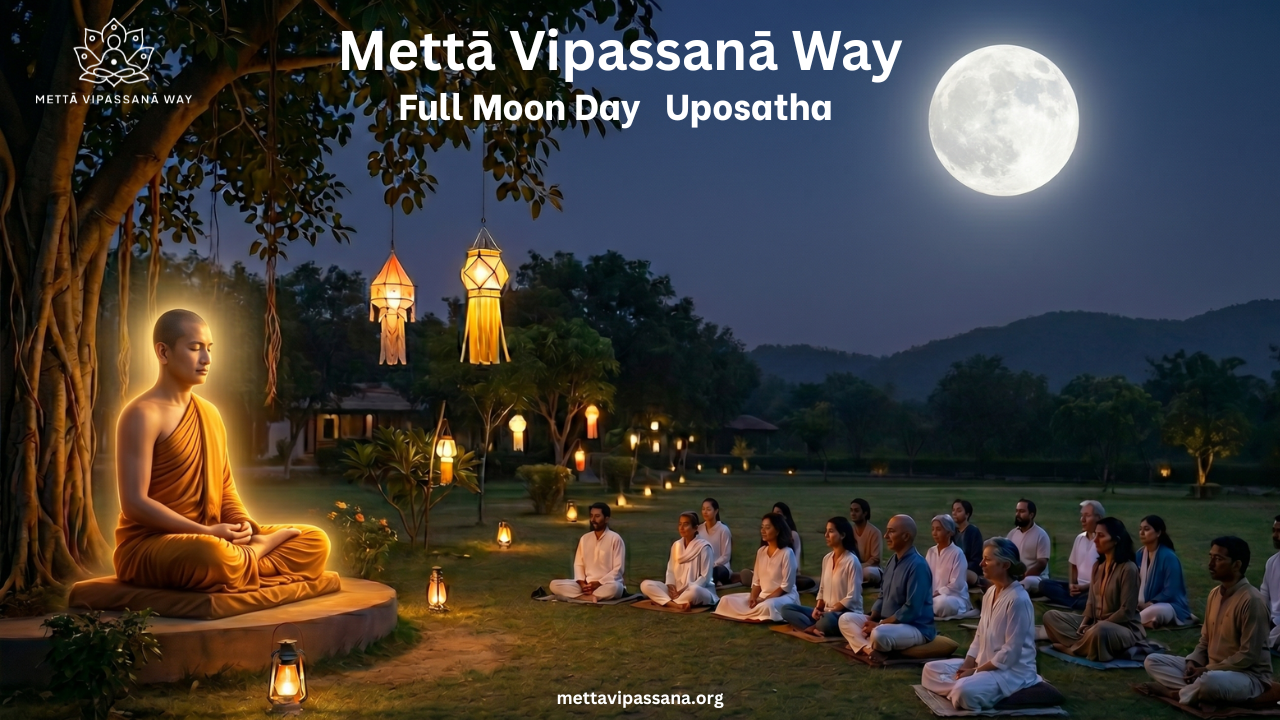
On the recent full moon Uposatha day, our community gathered to practice generosity, keep precepts, and train the mind through meditation. During this special retreat, Bhante Dhammagavesi delivered an inspiring Dhamma talk based on the Sona Sutta (AN 6.55).
If you feel frustrated because your mind refuses to settle down, this teaching reveals the exact solution. Bhante explained that pushing too hard actually holds you back. Instead, the secret to awakening lies in finding a perfect balance in meditation.
The Monk with Bleeding Feet
Our story begins during the time of the Buddha on Vulture Peak Mountain. A young monk named Venerable Sona practiced with intense energy. He wanted liberation so desperately that he completely gave up sleep.
Furthermore, Sona walked all night on the rough sides of the road. He stepped directly on sharp pebbles and thorns until his feet bled heavily. Yet, despite this extreme pain, his mind remained trapped in attachment.
Exhausted and sad, Sona thought about quitting the monkhood. He decided he would rather return to his wealthy family, enjoy his riches, and simply perform basic charity.
However, the Buddha read Sona’s mind from afar. Instantly, the Blessed One vanished from the mountain and appeared right in front of the struggling monk.
Tuning the Veena: The Law of Balance
The Buddha sat down and gently asked Sona about his thoughts. Sona honestly admitted his deep frustration.
To help him, the Buddha used an example from Sona’s past life as a skilled musician who played the Veena, a stringed Indian lute.
The Buddha asked:
“When the strings of your Veena were pulled too tight, was it easy to play?”
“No, Bhante,” Sona replied. “The sound was harsh, and the strings would snap.”
“And when the strings were too loose, did it make good music?”
“No, Bhante. It made a dull sound, and I could not play at all.”
“But when the strings were tuned to a perfectly balanced pitch, was it sweet and easy to play?”
“Yes, Bhante,” Sona answered.
Consequently, the Buddha delivered the golden rule of the Middle Way. If you apply energy too forcefully, you create restlessness. If your energy is too weak, you slide into laziness and sleep. Therefore, you must master a healthy balance in meditation.
Finding Equilibrium in Metta Vipassana
Bhante Dhammagavesi explained how this applies perfectly to Tranquil Wisdom Insight Meditation (TWIM) and the Metta Vipassana way.
When we meditate, we must harmonize our mental qualities. Aggressive willpower fills the mind with agitation. Conversely, zero effort causes us to fall asleep.
Therefore, you must keep your mind light, joyful, and alert. By adjusting your effort—just like tuning a musical instrument—your mind naturally cools down. As a result, it enters a state of deep tranquility and stable collectedness.
Once Venerable Sona applied this lesson, he stopped punishing his body. He practiced with an even mind and quickly achieved complete awakening. He became a fully liberated Arahant.
The Unshakeable Mind
After achieving liberation, Venerable Sona described the six natural qualities of an awakened mind. An Arahant lives with complete renunciation, solitude, non-affliction, and zero confusion.
To illustrate this beautiful state, the Buddha used a powerful comparison:
The Simile of the Stone Mountain: Imagine a massive, solid rock mountain. Even if a violent rainstorm blows in from any direction, it cannot make the mountain shake, wobble, or tremble.
In the exact same way, a balanced mind remains completely unshakeable. When sights, sounds, or thoughts arise, the liberated person does not cling to them. They simply watch the experience arise, and they calmly watch it vanish away.
Supporting the Spread of Dhamma
To ensure these precious teachings reach everyone, the Samatha Vipassana Trust (SVT) and the MettaInsight Foundation work continuously to organize retreats. We support full-time coordinators and cover travel and food costs for our teachers.
If you wish to support our mission, please consider making a donation using the links shared below.
May all beings be happy, peaceful, and liberated.
Frequently Asked Questions (FAQs)
1. What is the core message of the Sona Sutta?
It teaches us that spiritual progress requires a healthy balance in meditation rather than extreme struggle or laziness.
2. Why did Venerable Sona fail at first?
Sona forced his effort too aggressively, which caused extreme physical pain and mental restlessness.
3. How does the Veena analogy help my practice?
It shows that your mind works best when it is alert but completely relaxed—neither too tight nor too loose.
4. What happens if I use too much effort?
Over-effort creates tension in your body, leads to frustration, and makes you want to quit.
5. What happens if my effort is too weak?
You will easily lose focus, fall into deep daydreams, or fall asleep.
6. How does this connect to Metta Vipassana and TWIM?
TWIM emphasizes a light, joyful, and relaxed mind, which automatically creates the perfect balance needed for insight.
7. Who is an Arahant?
An Arahant is a fully liberated person who has completely uprooted greed, hatred, and delusion.
8. What is the meaning of the Stone Mountain comparison?
It represents a mind that remains perfectly steady and peaceful, no matter what external storms arise.
9. Does an Arahant suppress thoughts?
No. An Arahant simply observes thoughts and sensations arise and vanish without getting emotionally attached.
10. How can I practice balance in daily life?
Approach your work and daily activities with a calm, present mind, avoiding both intense anxiety and lazy carelessness.
Sharing of Merits
We close this reflection by sharing the wholesome energy created by this Dhamma discussion:
May suffering ones be suffering free, and the fear-struck fearless be.
May the grieving share all grief, and may all beings find relief.
May all beings share this merit that we have thus acquired for the attainment of peace and wisdom. May beings inhabiting space and earth,
Devas and Nagas of mighty power, share this merit of ours. May they long protect the Buddha’s dispensations.
Thank you to everyone who joined our full moon retreat. Keep your practice balanced, stay joyful, and see you at the next retreat!
