

Learn how mental proliferation (papanca) hijacks your mind and how TWIM meditation offers a practical way to stop the thought tornado, from MN 18 the Honey Ball Sutta.
Understanding Mental Proliferation (Papanca): How a Single Thought Becomes a Tornado
Have you ever noticed how a single passing thought can snowball into a 15-minute mental saga? You sit down to meditate, and a stray memory floats in. Before you know it, you are reliving an argument, planning a rebuttal, and feeling your body tense with frustration — all from a thought you never invited. This process has a name in Buddhist psychology: papanca, or mental proliferation. And 2,500 years ago, the Buddha described its mechanics with striking precision.
On Day 6 of the Kalimpong Retreat (April 2025), Metta Vipassana Way teachers unpacked one of the most practical suttas in the Pali Canon — MN 18, the Madhupindika Sutta, also known as the Honey Ball Sutta. This discourse lays bare the chain reaction that turns a simple sense contact into a full-blown mental storm, and — more importantly — shows us exactly where we can intervene.
The Setting: A Provocation the Buddha Refused to Take
The sutta opens with a wonderfully human scene. The Buddha has finished his morning meal and gone to sit under a tree for meditation — not unlike what retreat participants do each day after lunch. A man named Dandapani wanders into the grove and spots the Buddha. Rather than approaching respectfully, he issues a challenge: “So what does the recluse assert? What does he proclaim?”
It is not a sincere question. It is an invitation to argue.
The Buddha’s response is remarkable: “Friend, I assert and proclaim my teaching in such a way that one does not quarrel with anyone in the world.” He explains that he does not hold positions for the sake of defending them. He is not playing the game of argument. He lives in a way where “perceptions no more underlie” him — detached from sensual pleasures, without perplexity, free from craving for any kind of being.
Dandapani, clearly unimpressed, shakes his head, wags his tongue, furrows his brow into three lines, and walks away tapping his stick. It is a vivid piece of ancient storytelling that captures a universal human moment: the frustration of someone who came looking for a fight and could not get one.
The Question That Changes Everything
Later that evening, the Buddha recounts this exchange to his students. One of them asks the crucial question: How is it that the Buddha does not quarrel with anyone? How is it that perceptions no longer underlie him?
The Buddha gives a compact, profound answer that requires careful consideration: “As to the source through which perceptions and notions born of mental proliferation beset a man, if nothing is found there to delight in, welcome, and hold to, this is the end of the underlying tendency to lust, to aversion, to views, to doubt, to conceit, to desire for being, and to ignorance. This is the end of resorting to rods and weapons, of quarrels, brawls, disputes, recrimination, malicious words, and false speech.”
Then, without further explanation, he stands up and walks away.
Mahakaccana Unpacks the Teaching
The students are left stunned. They realize they should have asked the Buddha to elaborate while he was sitting right in front of them. So they turn to the Venerable Mahakaccana, whom the Buddha himself had praised as “foremost in expounding the detailed meaning” of brief teachings.
Mahakaccana gently chides them — it is like searching for heartwood among the branches and leaves of a tree while ignoring the root and trunk. But he agrees to explain.
The Chain Reaction of Mental Proliferation
Here is the core teaching that Mahakaccana lays out, and it is directly observable in meditation practice:
- Contact: Dependent upon the eye and forms, eye consciousness arises. The meeting of these three is contact.
- Feeling: With contact as condition, there is feeling — pleasant, unpleasant, or neither.
- Perception: What one feels, one perceives. Perception is the naming function of the mind — it draws on memory, labels experiences, and categorizes them.
- Thinking: What one perceives, one thinks about. The label triggers associated thoughts.
- Mental Proliferation (Papanca): What one thinks about, one mentally proliferates. This is where a thought takes on a life of its own, spiraling into more complex stories and emotional reactions.
- Being Beset: With mental proliferation as the source, perceptions and notions born of proliferation beset a person with respect to past, future, and present experience.
This chain applies not just to seeing. It operates through all six sense doors: the eye and forms, the ear and sounds, the nose and odors, the tongue and flavors, the body and tactile sensations, and the mind and mental objects.
The Tornado Metaphor
As the retreat teachers described it, mental proliferation works like a tornado. A thought begins as a small seed — a flicker of memory, a sense impression, a passing image. But then the tornado starts pulling in other material: related memories, emotional associations, imagined scenarios, judgments, and narratives. The thought-tornado takes on a life of its own, dragging you along for the ride.
How many times in meditation has an unbidden image appeared in your mind, and before you realized it, you were five or ten minutes deep in an elaborate story you never chose to think about? That is papanca in action.
The word itself carries rich cultural meaning. In Indian usage, papanca is associated with samsara — the continuing cycle of becoming. To say someone “does a lot of papanca” means they engage in excessive argumentation and conflict. The word captures both the internal whirlwind and its external consequences.
The Stickiness of Taking It Personally
There is another way to understand what makes proliferation so hard to shake. As one teacher put it: “I liken this to having honey on your fingertips. When you’ve got honey on all your fingertips, you cannot tell if the world is sticky or your fingers are. And when you apply the Six Rs, it’s like you put your sticky fingers in some warm water. And then you can tell whether it was your fingers that were sticking or the world.” The stickiness of the fingers is what happens when we take our experience personally — everything we touch seems to cling, but the problem was never “out there.” It was on our hands the whole time.
The Danger Even in Pleasant Things
The teachers pointed out that the Buddha never denied that there is genuine enjoyment in the world. He spoke of “the gratification, the danger, and the escape.” The danger is that all pleasant things are impermanent, and when we do not understand that, we resist their passing — and the proliferation begins.
One teacher illustrated this with an escalating comedy of paranoia: “If you have a million dollars in inheritance, what are you afraid of? Government will take away in tax. Then what do I have to do about tax planning? Then relatives will start calling. Then thieves are there.
Then total goons — ‘Oh, this guy has a million dollars, maybe we have to raid him.’ Then you have to protect yourself. You have to have an electric wall and CCTV cameras.” The million dollars is real gratification — you can go on vacations, have parties, enjoy nice things. But the danger proliferates right alongside the pleasure, each worry spawning the next, until you are a prisoner of the very thing that was supposed to make you happy.
Where You Can Intervene: The Practical Power of This Teaching
What makes MN 18 so valuable for meditators is that it does not merely describe the problem — it maps out every point where you can break the chain. As the sutta states: when there is the manifestation of contact, it is possible to point out the manifestation of feeling; when there is feeling, it is possible to point out perception; and so on through the entire sequence.
This means:
- If you catch contact, the rest does not happen.
- If you see feeling arise, you can release before perception takes over.
- If you notice perception — the naming, the memory drawing in — you can step back.
- If the thought has started, you can recognize it before it proliferates.
- Even if the tornado has been spinning for several minutes, the moment you recognize it, you can stop.
Each of these is a valid point of intervention. Some will be clearer at certain times; others will reveal themselves as practice deepens. The key insight is that awareness at any point in the chain is effective.
The Six Rs in Action
This is precisely where the Six Rs of TWIM meditation become a practical tool. When you recognize that proliferation has taken hold:
- Recognize what has happened.
- Release the attachment to the thought.
- Relax the tension that has built up.
- Re-smile to restore a gentle, open attitude.
- Return to the meditation object.
- Repeat as needed.
Each time you do this, you are reinforcing the recognition of dependent origination. You are training the mind to see the chain reaction in real time. It is not a failure of meditation when you get caught in proliferation — it is the meditation itself. The moment you recognize what happened, you were meditating, and the recognition is “immediately effective,” as the teachers emphasized.
The Honey Ball: Why This Teaching Is Sweet at Every Level
At the end of the sutta, the Buddha gives the discourse its memorable name. He says it is like a honey ball — wherever you taste it, you find a sweet and delectable flavor. Similarly, any earnest practitioner who examines this teaching with wisdom will “find satisfaction and confidence of mind” no matter which aspect they investigate.
This is an apt description. Whether you are a beginning meditator just learning to notice when you have drifted off, or an experienced practitioner observing the subtlest movements of perception, this teaching meets you where you are and offers something useful.
Practical Wisdom: From the Cushion to Daily Life
The retreat teachers extended this teaching into everyday activity with a question from a participant about walking meditation and daily tasks like brushing teeth or cooking.
The guidance was clear: whether sitting, walking, or doing daily activities, the object of attention is the quality of the mind itself — whether it is expansive and radiating, or contracted and tense. You do not need to make the activity itself the formal meditation object. Instead:
- Notice when tension arises in the body or mind.
- Relax and soften back into an open, expansive state.
- Continue with the task at hand, simply remaining sensitive to when contraction returns.
As one teacher put it: “Relaxing and softening is loving-kindness. When you soften, the mind expands. You go back to your work. You just become more sensitive to when the tension is there.”
This approach transforms every moment of the day into an opportunity to practice — not through rigid effort, but through a gentle, ongoing attentiveness to whether you are holding on or letting go.
How Even the Buddha’s Mind Still Thought
A participant asked a penetrating question: if the cycle of dependent origination starts with ignorance, what happens when ignorance is gone? Does an awakened person stop thinking entirely?
The teachers explained that the enlightened mind still thinks, still makes decisions — but the actions are no longer karma (actions with karmic consequence). They become kiriya — acts that carry no karmic residue, because they are not rooted in craving or clinging.
The Buddha himself once reflected that monks would be happier and have fewer troubles if they ate only one meal a day. This was a practical response to real problems: monks who went out in the evening to collect alms were “falling into ditches, chased by dogs, considered to be ghosts — and people were getting afraid!” To resolve this, the Buddha made the rule: one meal a day, before noon. The decision arose not from craving, but from a clear-eyed response to a practical problem.
Confidence and Humility: The Balance That Sustains Practice
The evening’s discussion also touched on a common obstacle: the feeling of “not being good enough.” The teachers reframed this as a question of responsibility rather than self-judgment:
- Confidence comes from honestly recognizing what you have already learned and how far you have come.
- Humility comes from acknowledging what remains to be understood.
- Responsibility means not simply labeling yourself but actively engaging with your own growth.
If confidence becomes arrogance, you stop being teachable. If humility collapses into self-deprecation, you deny yourself the possibility of learning. The balance between the two — honest confidence and genuine humility — is what sustains a long-term practice.
This is also why the retreat does not impose rigid schedules or constant supervision. The teachers explained that taking personal responsibility during the retreat prepares you to maintain the practice in daily life, long after the retreat is over.
The Handful of Leaves — and the Raft That Does Not Need to Be a Cruise Ship
The talk closed with two of the Buddha’s most beloved similes. He once picked up a handful of leaves and asked his students: “Which is more — the leaves in my hand or the leaves in the forest?” The answer was obvious: the leaves in the forest. “Yes,” the Buddha said, “but the leaves in my hand are all that you need.”
The mind can endlessly entertain us with complexity. It can produce shinier, more elaborate, more captivating versions of any idea. As the teachers put it: “Whatever you want, the mind can produce — in a stickier version.” But the task is simple: recognize when proliferation has begun, release the grip, and return to the present. The tools are few — the Six Rs, an understanding of dependent origination, and a willingness to be honest with yourself. That handful of leaves is enough.
The same point applies to the practice itself. One teacher invoked the Buddha’s famous simile of the raft — we use the Dhamma to cross the river, not to build a permanent vessel. “The raft just needs to be good enough to get you across. It doesn’t need to look like the QE2.” It is a wonderfully deflating image: you do not need to over-engineer your practice or master every doctrinal subtlety. You just need what works to get you to the other shore.
And if you need a cautionary tale about getting distracted by the scenic route, there is the story of Anuruddha. Sariputta, the Buddha’s wisest disciple, met Anuruddha one day and asked how things were going. Anuruddha proudly announced that in his meditation he had been traveling around the 10,000 world systems—a vast, cosmic range of existence. Sariputta’s response was blunt: “What are you doing? Why are you spending your time doing that?” How is that helping? You know the task at hand. You know what you need to do. Stop getting distracted. Anuruddha was, as the teacher recounted, “a bit shamefaced” — but he understood the wisdom in the rebuke.
As the teachers reminded participants: “Is it necessary? Is it useful? Is it timely? And is it real?”
Those four questions, applied with sincerity, can cut through any amount of mental proliferation.
Key Takeaways
- Mental proliferation (papanca) is the process by which a simple sense contact spirals into elaborate thought-stories that “beset” us.
- The chain runs: contact, feeling, perception, thinking, proliferation — and it operates through all six sense doors.
- You can intervene at any point in the chain. Even catching the tornado 15 minutes in is a success.
- The Six Rs are the practical tool for breaking the chain during TWIM meditation.
- In daily life, stay attentive to tension and contraction. Relaxing back into openness is itself the practice of loving-kindness.
- Balance confidence with humility, and take personal responsibility for your practice.
- Keep it simple. A handful of leaves is all you need. The raft does not need to look like the QE2.
Watch the Full Talk
This blog post is based on the Day 6 evening Dhamma talk from the Kalimpong Retreat, April 2025, led by teachers from Metta Vipassana Way. To hear the complete teaching, including the full Q&A discussion, watch the video below:
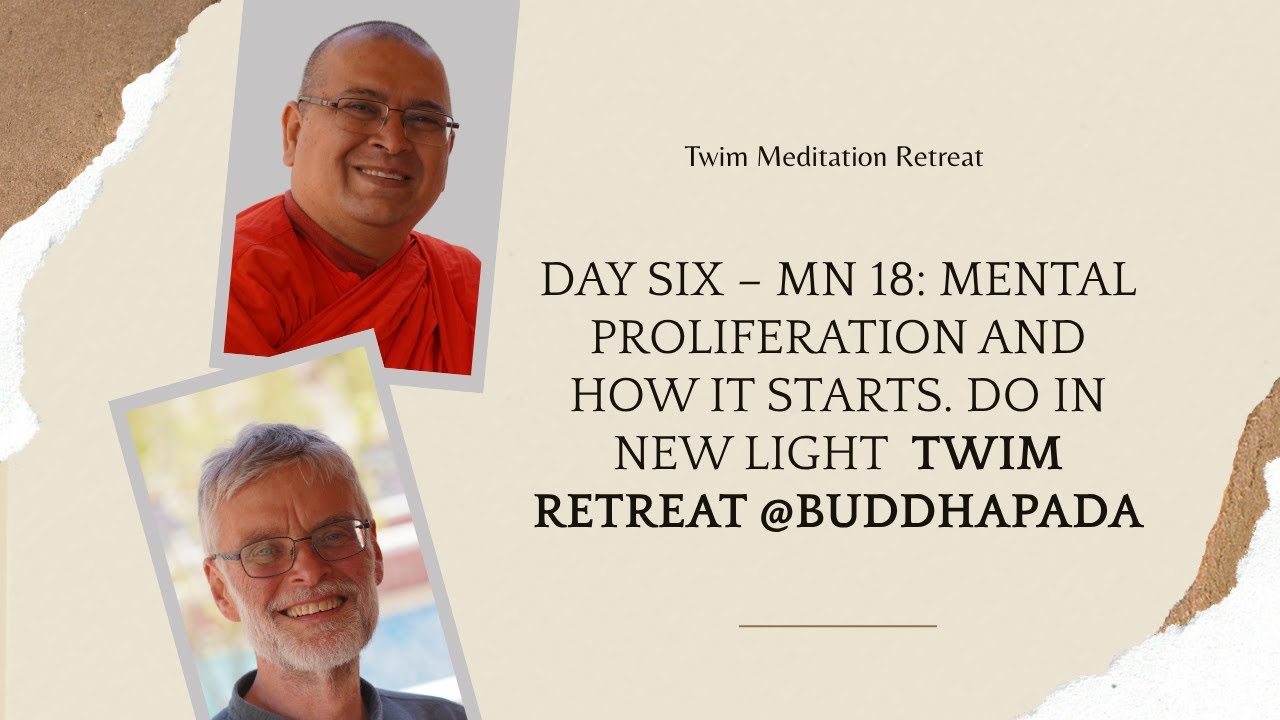
Watch: Day 6 – Mental Proliferation (Papanca) & The Honey Ball Sutta | Kalimpong Retreat 2025
For more information about upcoming retreats and TWIM meditation resources, visit mettavipassana.org.


So beautifully said. During deep meditation memories pop up – unsettling / unnerving. There are times when one can watch…