

Explore the stages of meditation progress mapped out in MN 111 (Anupada Sutta) — from first jhana to cessation — as taught at the Kalimpong TWIM retreat.
A Roadmap to Progress in Meditation: Lessons from MN 111 (Anupada Sutta)
What does real progress in meditation actually look like? Is there a map we can follow — a sequence of experiences and understandings that mark the path from beginner to fully awakened? According to the Buddha, the answer is yes.
On Day 3 of the Kalimpong Retreat (April 2025), the teaching turned to one of the most detailed roadmaps in the entire Pali Canon: MN 111, the Anupada Sutta (“One by One as They Occurred”) from the Majjhima Nikaya. This sutta describes the meditative journey of Sariputta, the Buddha’s foremost disciple in wisdom, as he progressed through every stage of jhana, the formless attainments, and finally cessation itself.
For practitioners of TWIM (Tranquil Wisdom Insight Meditation) and metta vipassana, this teaching is not merely historical. It is a practical guide to what you may encounter on the cushion and how to relate to each experience as it arises.
Sariputta: The Disciple Who Analyzed Everything
The Buddha introduced the teaching by praising Sariputta’s wisdom — calling it great, wide, joyous, quick, keen, and penetrative. Sariputta was considered the Buddha’s “right-hand monk,” renowned for his wisdom, while Moggallana, the “left-hand monk,” was known for his psychic abilities. The difference between them, however, was said to be very minor.
One telling detail: when both monks first received the teaching, Moggallana attained awakening in 7 days, while Sariputta took 14. This was not because Sariputta was less capable; rather, he paused to analyze what was happening at each stage of practice, examining every shift in his mind as it occurred. This analytical approach, though it took longer, resulted in a detailed record of the mind’s journey that continues to benefit practitioners today.
The First Jhana:
Where the Journey Begins
The sutta begins with a foundational principle: to enter the first jhana, one must be secluded from sensual pleasures and secluded from unwholesome states. These unwholesome states are the five hindrances:
- Sensual desire — craving for pleasant sense experiences
- Ill will (aversion) — irritation with a person, a sound, the temperature, or anything in the present moment. Sometimes you have aversion with sound coming up — tuk tuk tuk tuk tuk — the whole day they are kind of making a sound. Or you may have aversion with the climate: some people may feel the same temperature as too cold, some may feel the same temperature is too hot. So you have aversions to what is there in the present.
- Sloth and torpor — sleepiness and dullness
- Restlessness and remorse — an agitated, unsettled mind
- Doubt — “Am I doing this right? Is this practice working?”
Any practitioner will recognize these visitors. They arise for everyone. The key insight is that when these hindrances subside, a distinct mind state naturally emerges. This is the first jhana.
The first jhana is characterized by thinking and examining thought, joy, happiness felt in the body, and unification of mind — the ability to stay on the object of meditation. Importantly, you can still think, contemplate, and direct attention. This is not a zombie state or a shutdown. The mind is aware, functional, and observing.
What does “thinking and examining thought” actually look like? The teacher gave a vivid illustration of how the mind drifts: you think of an elephant, which reminds you of the Great Wall of China, which leads to thoughts of history, and so on. This continuous, associated thinking is what remains present in the first jhana.
The teaching emphasized that contact, feeling, perception, volition, mindfulness, energy, equanimity, and attention are all still operating. You can still feel a fly landing on your arm. You can still make choices — like recognizing when the mind has wandered and gently bringing it back using the six Rs (recognize, release, relax, re-smile, return, repeat).
Progressing Through the Jhanas: What Falls Away
As meditation deepens, the sutta traces a pattern: at each successive stage, something falls away, and what remains grows more refined.
The Second Jhana
With continued practice, thinking and examining thought drop away. The mind becomes calmer, and what arises is self-confidence — a quiet sense that “I think I am understanding this practice.” There is singleness of mind (stronger unification), and joy and happiness remain, now born of collectedness rather than initial seclusion.
The Third Jhana: Pleasant Abiding
In the third jhana, joy fades. What remains is equanimity, mindfulness, full awareness, and happiness still felt in the body. The body becomes deeply comfortable — so comfortable that you may not feel your arm or leg unless you direct attention there.
This state is what the noble ones (the Buddha’s awakened students) called “pleasant abiding.” Whenever you encounter this term in the suttas, it refers to the third jhana — a state pleasant in both body and mind. The awakened ones would rest here because it was such a comfortable state.
The Fourth Jhana: The Highest Human Mind State
In the fourth jhana, both pleasure and pain are abandoned. The mind is profoundly balanced — no joy arising, no bodily pleasure, but also no discomfort. There is purity of mindfulness due to equanimity.
The teaching offered a striking claim: the fourth jhana is the highest state of mind a human being can experience, and it can only be reached through meditation. You cannot stumble upon it.
There is, however, a similar but fundamentally different state in everyday life—like when you are riding a bus and several stops pass without your noticing. You were awake, but there was no awareness of time passing. This state of “zoning out” is characterized by ignorance or a lack of conscious presence. The fourth jhana, by contrast, is a state of profound clarity with full mindfulness and purity of awareness.
An analogy was used for equanimity across the jhanas: in the first jhana, equanimity is like a one-legged stool. In the second, two-legged. In the third, three-legged. In the fourth, it is like a four-legged table — deeply stable.
The Formless Attainments: Beyond the Body
Beyond the four jhanas lie four formless (arupa) attainments — stages of the fourth jhana where the perception of the physical body recedes.
The Base of Infinite Space
The meditator may experience a feeling of expansion, of spaciousness, of the room growing larger or the self growing smaller. There is an awareness of space itself. At this stage in the Brahma Vihara practice, the feeling of metta may naturally shift into compassion — a softer feeling that one might initially mistake for metta weakening. It is not weakening; it is changing.
The Base of Infinite Consciousness
Here the meditator may experience the arising and passing away of consciousness itself. The eyes may seem to flash. Sensations may feel like ants crawling on the skin. Sounds may arrive broken, with gaps between them. This is seeing the rapid cycling of consciousness—what the teacher described as potentially 100,000 cycles of arising and passing away in a single moment, so fast that we normally perceive everything as simultaneous, just as film frames create the illusion of motion.
The Base of Nothingness
Equanimity matures further. The meditator may perceive a black screen or sometimes a white one, with the mind simply balanced and observing. Subtle phenomena may arise — lights, images, colors, memories.
The instruction is clear: do not engage with them. If you pay attention to light, the light will give you a light show. One light will become two lights. Two lights will become three lights. And then there will be a light show.
And if you see the colors, then there will be multicolors and millions of colors and billions of colors. You can see, “Oh, so I saw these colors which I never seen in my life.” But that is the mind trying to take you away. The mind does not like to be over there because it doesn’t have any habit of being in that state of mind. So it wants to take you away to what is familiar.
This is where the practice of letting go becomes paramount. As taught in MN 19 (discussed earlier in the retreat), the core practice is renunciation — releasing preferences, releasing attachment to pleasant states, and simply observing. Only through observation can you see how the mind works, where attachments lie, and how to release them.
A powerful teaching was offered here: whatever is arising in the present has its source in the past. If you do not apply mindfulness and right effort in the present, your future will look like your past. If anger arose before, it will arise again. If sadness arose before, it will arise again. The only intervention point is now.
As the teacher put it, quoting Bhante: “Bhante, my teacher, used to say that there are no shoulds in Buddhism. There is no ‘that you should do this.’ But if you do this, this happens.” It is a cause and effect relationship. If this is there, this comes to be. If this arises, this arises. If this is not there, this does not come to be. If this does not arise, that does not arise.
The Base of Neither Perception Nor Non-Perception
This is the most subtle of all the formless attainments. A key difference was highlighted: in this state, Sariputta could not observe what was happening in the present moment. He could only contemplate what had occurred after emerging from the attainment. He “looked in the rearview mirror.” Additionally, certain mental factors like volition were no longer present.
It is a gray area of the mind — not perception, but not the absence of perception either. Practitioners may wonder: “Was I there? Did I fall asleep? Were there gaps?” The teacher noted that the term “quiet mind” was coined to make this state easier to discuss, since trying to directly discuss “neither perception nor non-perception” can quickly lead to confusion.
An important practical note: this state cannot be sustained during walking meditation. During walking, one can maintain equanimity or nothingness, but not this most refined attainment.
Cessation: The End of the Road
Beyond neither perception nor non-perception lies the cessation of perception, feeling, and consciousness. In this state, Sariputta’s “taints were destroyed by seeing with wisdom” — his attachments, the chains binding him to suffering, were broken.
Like the previous attainment, Sariputta could only recall what had happened after emerging. But upon emerging, he confirmed something definitive: “There is no escape beyond this.” At every prior stage, Sariputta had confirmed “there is an escape beyond” — there was always something further. At cessation, the journey was complete. This was nibbana.
The Core Insight: Impersonal, Arising, and Passing Away
Running through every stage of the sutta is a single observation that Sariputta made again and again:
“Known to him those states arose, known they were present, known they disappeared.”
He did not create these states. He witnessed them. They arose on their own and vanished on their own. This is the insight into impersonality (anatta) — the understanding that these experiences are not “mine,” not controlled by a self.
The Buddha’s example of the body was offered: Can you change your skin color by willing it? Your eye color? Can you make the body younger? You cannot, because the body is not truly “yours” to command. The same applies to mental states.
At each stage, Sariputta abided unattracted to pleasant experiences and unrepelled by unpleasant ones — independent, detached, free, with a mind rid of barriers.
The Four Stages of Awakening
The talk concluded with an overview of the four stages of awakening recognized in the Buddhist tradition:
1. Sotapanna (Stream-Enterer): Understands three things — confidence that the practice leads to awakening, understanding that rites and rituals alone do not lead to awakening, and insight into the impersonal nature of phenomena. A sotapanna has at most seven lifetimes remaining.
2. Sakadagami (Once-Returner): Sensual lust and aversion are significantly weakened — across all senses including sight, sound, smell, taste, touch, and thought. Will return to the human realm only once more.
3. Anagami (Non-Returner): Lust and aversion are fully abandoned. Five subtle attachments may remain: desire for existence in the human or higher realms, restlessness, a faint sense of “I” (conceit), and ignorance.
4. Arahant (Fully Awakened): All attachments are released. The Buddha offered a simple test: if sensual lust, aversion, or delusion (taking things personally) still arise in the mind, one is not yet fully awakened. If they do not arise, one is.
The sutta speaks of Sariputta’s mastery in noble virtue — the precepts. In the retreat, practitioners keep seven or eight precepts. For monks, it is 227 precepts, and for nuns (Bhikkhunis), it is 311. This commitment to virtue provides the stable foundation upon which deep meditation is built.
The teaching noted that in the Buddha’s time, there were more than 500 lay men and lay women who were stream-enterers, more than 500 monks and nuns at each stage, all the way up to more than 500 monks and more than 500 nuns who were arahants. Awakening was not rare or reserved for a special few. It was — and remains — accessible.
Two Types of Understanding Working Together
A valuable framework was offered for how understanding develops in practice. There are two types of knowledge that work together:
- Experiential understanding — what you discover directly on the cushion, testing and seeing results for yourself.
- Framework understanding — the structure provided by the Buddha’s teachings, which extends beyond your current experience but is not beyond your capacity to understand.
As practice develops, personal vision begins to match the framework. What was once intellectual knowledge becomes integrated, lived understanding. The Buddha described this as a gradual progress directed by personal experience.
The teaching was careful to note: the Buddha’s teaching is not to be taken on face value. You observe it, test it, see if it holds in your experience, and check whether it applies universally. The Buddha’s teaching, it was said, is universal — not limited to a particular instant or context.
Practical Takeaways
- Trust the process. Each stage of meditation builds on the last. Progress happens through a natural falling away of mental factors, not through force.
- Do not cling to pleasant states. Joy, bliss, and comfort will arise and pass. Let them. The practice is about observation and letting go.
- Do not fear difficult states. Pain, restlessness, and doubt also arise and pass. They have a timeline.
- Use the six Rs consistently. Recognize, release, relax, re-smile, return, repeat. This is how you work with hindrances at every level.
- Observe, do not analyze excessively. Sariputta’s analysis gave us a map, but in your own practice, prioritize observation over intellectual dissection.
- Apply mindfulness now. The present moment is the only intervention point. Without mindfulness and right effort today, your future mind will replay the patterns of the past.
- Test everything. Do not accept teachings on faith alone. See if they hold up in your own direct experience.
Watch the Full Talk
This article is based on the Day 3 talk from the Kalimpong Retreat (April 2025) by Metta Vipassana Way. To hear the complete teaching with all its nuances, watch the full video:
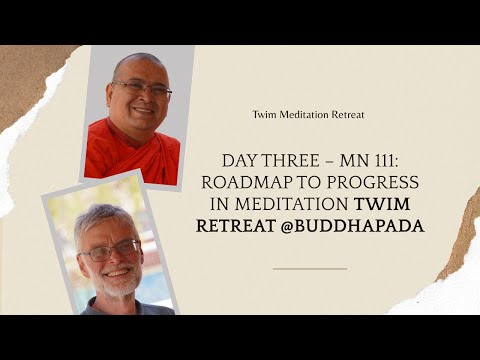
This talk is part of the Kalimpong Retreat series (April 2025) by Metta Vipassana Way, teaching TWIM (Tranquil Wisdom Insight Meditation) and Metta Vipassana. For more teachings and retreat information, visit mettavipassana.org.


So beautifully said. During deep meditation memories pop up – unsettling / unnerving. There are times when one can watch…